
As technology advances and theft trends change, loss prevention (LP) best practices are getting an overhaul at convenience stores. Retailers and experts agree that we’re in the midst of a big shift in the c-store industry from the reactive LP of yesterday to a more modern proactive risk management approach.
“Convenience operators are no longer just responding to incidents; they’re investing in identifying patterns before loss occurs,” elaborated Khris Hamlin, VP of asset protection, Retail Industry Leaders Association (RILA).
Wes Pate, VP, loss prevention & risk management, Refuel Operating Co. LLC, which operates 244 stores in South Carolina, North Carolina, Texas, Mississippi and Arkansas, is seeing this trend play out at store level, where LP practices are shifting from a security operation to, as he calls it, “a proactive business performance driver.”

“The practitioners who are generating the most executive support right now are the ones fluent in EBITDA contribution, trend analysis and cross-functional problem solving, not just case counts and recovery metrics,” Pate said. “What’s interesting is that organizations are beginning to recognize this, and LP professionals are being asked to carry more than just LP.”
For example, Pate leads not only the LP function at Refuel, but also the company’s Risk Management, Inventory & Audit and Sourcing & Value Optimization business units.
“This is a unique and rewarding part of working at Refuel, and the industry is increasingly acknowledging that LP professionals are equipped to derive value well beyond the traditional LP scope,” he said, noting that staffing models and organizational charts at most c-store chains haven’t caught up to this shift yet.
Crime Evolution
One reason for the movement toward a proactive approach is that crime itself is changing. Organized retail crime (ORC), or professional, coordinated theft, is continuing to grow, and it’s appearing more frequently in smaller-format environments like c-stores, Hamlin noted.
“These aren’t always large-scale grab-and-go events; they’re often repeat, targeted thefts focused on high-margin, easy-to-resell items like tobacco, over-the-counter medications and energy products,” Hamlin said. “Teams are being asked to manage not just shrink but also employee safety, customer incidents and broader operational risk.”
C-stores are also experiencing crime that is more calculated and repeated as opposed to the opportunistic theft of years past.
“Offenders are learning store routines, shift changes, staffing gaps, delivery windows and exploiting those moments,” Hamlin said. “There’s also an increase in ‘low-dollar, high-frequency’ theft, where individuals intentionally stay under prosecution thresholds but create significant loss over time.”
Pate agreed that on the merchandise side of the business, theft is becoming more calculated, with thieves showing a familiarity with store layouts, camera positioning and associate blind spots.
Hamlin noted it’s also more common to see small groups of thieves working together, with one person distracting employees while another shoplifts.
“In some cases, these activities are being organized or influenced through online channels, which accelerates how quickly tactics spread,” Hamlin said. “Retailers are also seeing more brazenness. The perceived lack of consequences in some jurisdictions has changed behavior, and retailers are feeling that on the front lines.”
David Johnston, VP, asset protection & retail operations, National Retail Federation, is also observing these trends. In addition, he pointed to a rise in fuel theft, payment fraud and phone-based scams “that manipulate employees into surrendering cash or access to sensitive information.”

“The common thread is exploitation of speed, trust and operational gaps — making awareness and pattern recognition more critical than ever,” Johnston said.
Fuel theft is where Refuel is seeing the most significant external loss. “Merchandise theft, while present, is far outpaced by fuel-related loss,” Pate explained. “The sophistication we are seeing in the manipulation of the pumps to get fuel, and the means these groups have to traffic this product, is concerning.”
A Holistic Approach
An emerging trend in LP is a focus on total retail loss, Johnston said, adding that it’s “a more holistic, data-driven view of shrink that goes beyond traditional LP metrics.”
“Rather than focusing only on internal and external theft, operators are measuring and managing losses associated with prepared food waste, overproduction, poor forecasting and execution gaps,” Johnston said. “The goal is to identify where loss occurs across the entire store and to align people, process and planning to protect margin and drive stronger performance.”
Pate is also observing a shift toward looking beyond shrink and focusing on overall store health.
“The convenience store industry has historically measured loss through a shrink lens: merchandise inventory variance (with) some food waste layered in when operators were being thorough, etc. We’ve moved past that framing entirely,” Pate said.
Refuel is focusing on net store health, which “encompasses every dollar leaving a store that shouldn’t,” he said. That means looking at merchandise shrink, fuel variance, food waste, cash-handling losses, damages and operational inefficiency.
“When you look at the full picture, the opportunity to improve store profitability is significantly larger than shrink alone,” Pate said.
In other words, it’s breaking down each loss category independently to uncover potential issues.
“Audit adjustment shrink and spoilage shrink have entirely different root causes and entirely different playbooks. Fuel variance and cash loss require different disciplines than merchandise. When you manage net store health as a unified concept but diagnose its components separately, you stop chasing a blended number and start making meaningful improvements to store-level profitability,” Pate said.
Technology Transforming LP
The c-store industry has evolved its use of technology in LP from “associates watching live cameras to exception-based reporting and remote monitoring,” Pate noted.
“What we’re deploying now is the next iteration: artificial intelligence (AI) layered on top of that exception infrastructure,” Pate explained. “Our current platform uses AI to analyze flagged transactions and corresponding video together, surfacing confirmed cases at a throughput that would be difficult to replicate manually. The time between a flag and a confirmed actionable case has compressed dramatically.”
Refuel is monitoring the evolution of LP technology because it’s changing at a rapid pace and the changes have implications for team structure and resources.
Johnston sees technology helping c-stores make the transition from “reactive investigation to proactive prevention.”
“AI-driven cameras and advanced analytics shift the focus from what happened to why loss occurs, uncovering behavioral patterns and operational blind spots in real time,” he noted. “This insight enables operators to intervene when repeat behaviors emerge and close process gaps earlier, reducing risk without adding friction or disrupting the business.”

David Johnston, VP of asset protection & retail operations, National Retail Federation
Hamlin concurred that today, AI-enabled video gives retailers the ability to identify behaviors as opposed to just incidents. “That means recognizing things like concealment, repeat offenders or suspicious movement patterns. It’s allowing teams to intervene earlier and more consistently, even without dedicated security personnel within the store.”
On the point-of-sale side of the business, advanced analytics are also helping c-stores find internal and external “risk patterns” much faster, Hamlin added.
“Instead of looking at reports after the fact, retail asset protection teams can now flag anomalies, like refund abuse, sweethearting or unusual transaction patterns, as they happen,” he said.
Refuel is pairing transaction analytics with automated video retrieval. “When a transaction meets defined risk thresholds, corresponding video is surfaced automatically rather than requiring manual search,” Pate said. “That exception-based model replaced live monitoring as the industry standard for good reason: it directs human attention where the data indicates it belongs.”
Now, Refuel is actively adding an AI layer to that strategy. “Our current platform applies AI to analyze flagged transactions and video together, compressing investigation time significantly and allowing a lean team to operate at a scale that simply wasn’t possible with manual review,” Pate said.
“There are so many ways that LP can help unlock the power of Vision AI and other use cases for our operational, food, merchandising, IT and all other business partners, as well, “ he added.
The technology available for LP is continuing to advance rapidly. Pate pointed to AI-powered cameras with license plate recognition in parking lots as an emerging tool to watch.
“Systems can now maintain watchlists of vehicles associated with prior incidents and generate real-time alerts when a flagged vehicle enters a property, shifting the security posture from reactive documentation to proactive intervention,” Pate explained. “In a fuel environment specifically, where the vehicle is the instrument of theft, that capability is particularly relevant.”
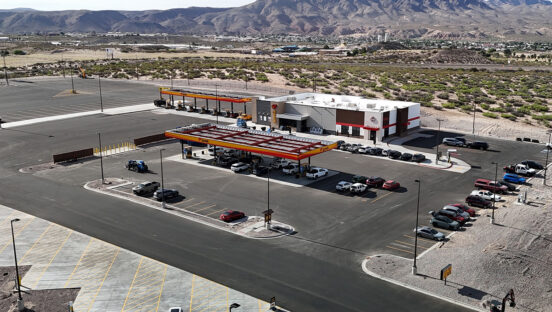
Drone-based surveillance has also entered early conversation, Pate pointed out. And platforms are beginning to provide autonomous aerial monitoring for large-format parking lots.
“We’re watching all of these technological programs closely while also watching operational and regulatory space, as those are still evolving. However, the directional capability is real,” Pate said. “The honest answer is that the technology is outpacing most LP programs’ ability to absorb and operationalize it. Staying current requires deliberate investment in tools and in the internal capability to use them well.”
One of the biggest opportunities for c-stores currently is to form collaborations with law enforcement and prosecutors.
“When those three groups are aligned, we move from isolated incidents to building stronger, prosecutable cases that actually address repeat offenders and organized activity,” RILA’s Hamlin said. RILA is also seeing momentum behind crime-linking technology.
“The ability to connect incidents across locations, identify repeat patterns and package that intelligence in a way that law enforcement and prosecutors can act on is a game changer. It gives retailers a much stronger position, not just to report crime, but to help drive meaningful outcomes,” Hamlin said. “At the end of the day, this isn’t just about reducing shrink. It’s about creating safer environments for employees and customers and building a system where accountability is consistent.”
Pate finds it refreshing that the c-store industry is starting to recognize the “breadth of capability that strong LP professionals bring.”
“The skills that make someone effective in loss prevention, (such as) analytical rigor, cross-functional influence, risk quantification, operational discipline, all translate directly into adjacent functions like risk management, inventory control, procurement and compliance,” Pate said. “The best practitioners aren’t just LP professionals anymore; they’re operational leaders who happen to have come up through LP. I’m proud to be an example of that evolution, and I expect we’ll see more of it as the function continues to mature.”