
As tobacco consumers increasingly turn to nontraditional nicotine alternatives, cigarettes still remain the most purchased tobacco product throughout the country, notching over $50 billion in dollar sales in the c-store channel over 52 weeks ending June 14, according to Chicago-based research firm Circana. Unit sales, however, dipped 5.3%, signaling consumers’ growing preference for alternatives.
Tobacco accessories are a bright spot in the space, with dollar sales ticking up 12% and unit sales climbing to 7.1%.
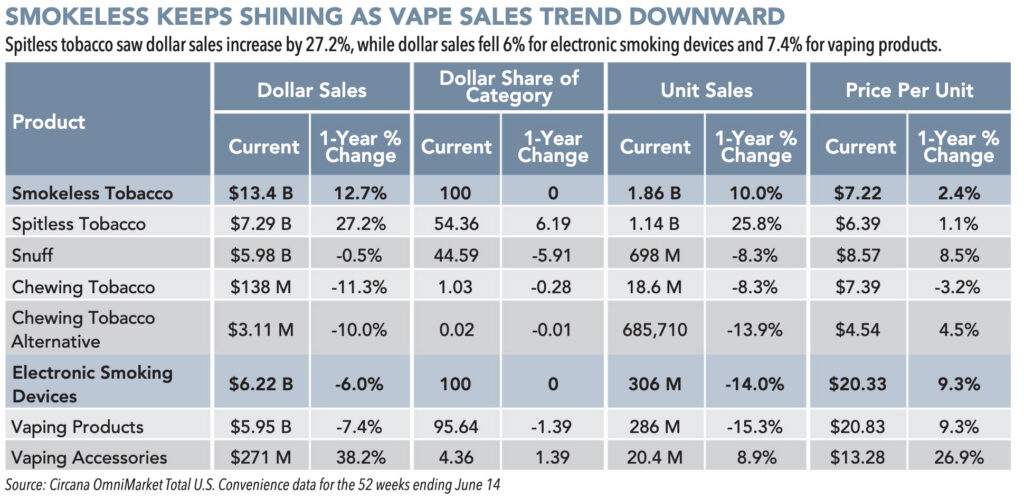
Still, the segment retailers should be keeping a close eye on is smokeless, and spitless tobacco specifically, as dollar sales shot up by 12.7% and unit sales by 10% — a trend that has continued for several years now.
As consumers shift to smokeless offerings, vape sales are slowing. While still accounting for over $6 billion in dollar sales, the segment saw declines of 6% and 14% in dollar sales and unit sales, respectively for the period.
And c-store retailers are feeling the pressure.
“Performance has become more challenging this year for certain with contributing factors such as economic pressures and tobacco promotion strategy changes,” said Jessica Starnes, director of loyalty and tobacco category manager for Knoxville, Tenn.-based Weigel’s, which operates over 90 stores across east Tennessee. “Cigarettes remain the No. 1 driver in overall sales, however (they are) still in a decline over the prior year. The most outstanding performer is the nicotine pouch segment.”
At Beaverton, Ore.-based Plaid Pantry, director of marketing Jon Manuyag said that as of May 2026, cigarette dollar sales and unit sales are down 2% and 8%, respectively, with moist chew also seeing downticks of 7% and 12%.
The difference maker in-stores, he said, is modern oral nicotine.
“Modern oral nicotine pouches continue to be the category offsetting those major declines,” said Manuyag. “Modern oral nicotine pouch trends are +29% in dollars and +17% in units. (There is) more innovation coming out of the big manufactures like ZYN and ON to drive a larger mix within their portfolio.”
Manuyag added that modern oral nicotine “continues to drive strong growth year over year,” and is “posting continued high double-digit increases in both dollars and units.”
Economic factors also play a massive role in tobacco product purchasing behavior. In 2026, consumers’ wallets are tightening as inflation continues to drive prices up industry-wide.
As a result, many consumers are shifting to lower-tier cigarettes to offset inflationary effects.
“Consumers are price conscious, especially when gas prices rise, which results in downtrading to less expensive products,” said NATO’s Spross.
At Weigel’s, Starnes is seeing a similar “downtrading” trend, noting that fourth-tier cigarette and nicotine pouch offerings are some of the “largest growth opportunities” in their stores.
“I believe, in the next five years, we will still have cigarettes on the backbar, (we will) possibly (add) heat-not-burn items, a continued expansion of nicotine pouches and hopefully a regulated vapor space,” she said.