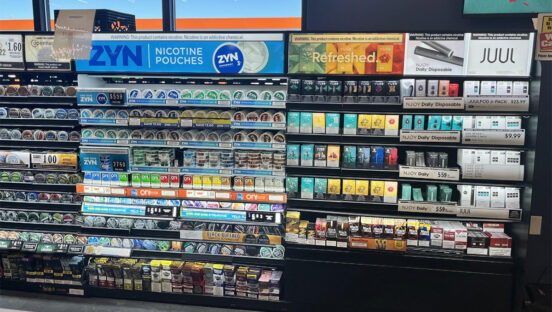

Convenience retailers have long managed the complex intersection of product innovation, regulatory pressure and evolving consumer preferences at the backbar. Now, the tobacco and nicotine category is facing market disruption and regulatory constraints at a level that requires strict observation and ever-sophisticated strategy. Particularly as the market varies greatly based on geography and core consumer, c-store operators cannot step back.
State and local policy decisions drive store-by-store adjustments as retailers stabilize the backbar, and an influx of offerings in a fragmented regulatory environment keeps retailers reassessing what earns space.
“What keeps me up at night isn’t the durability of the category so much as getting the balance right. Consumer behavior, pricing dynamics and regulation aren’t moving in sync, so staying disciplined requires constant recalibration,” said Tina Badger, category manager for CrossAmerica Partners LP, which operates 345 stores across 18 states. “In a highly regulated, margin-sensitive environment, relatively small decisions around space, emphasis or execution can have an outsized impact, and those consequences don’t always show up immediately. The challenge is maintaining clarity and focus as the category evolves, without over or underreacting to any single signal.”
Overall tobacco performance is steady with softer unit sales offset by surges in price. Still, “performance is highly market dependent and increasingly segmented by format,” Badger noted.
At CrossAmerica’s stores, traditional cigarettes anchor the category from a revenue standpoint, supported by disciplined price-tier management and strong brand loyalty, even as they face ongoing volume pressure.
“We continue to see a widening split in the cigarette category (with) price-sensitive consumers trading into fourth-tier offerings, while premium brands retain loyal customers who prioritize consistency and availability. Both tiers play distinct roles in sustaining category dollars and traffic,” said Badger.
Kalen Frese, director of merchandising and warehouse for Warrenton Oil Co., which operates 58 FastLane stores in Missouri, emphasized the importance of the fourth-tier brands. At FastLane, the low-priced cigarettes are driving unit sales as high-priced brand sales dip.
The change in the profitability of premium brands highlights the market-dependent nature of the category.

Regardless, cigarettes remain predictable, Badger said, and play an important role in basket contribution.
Nationally, the cigarette category at c-stores is up 1.6% for Q1, reaching $11.1 billion, and down 4% in unit sales. Price per unit increased by 5.9%, according to market research firm Circana.
Cigars saw similar 12-week results through March 22, upping 1.7% in dollars and dipping 4.1% in unit sales while notching a 6% uptick in price per unit.
The segment remains dependable for CrossAmerica Partners, particularly value and premium offerings, supported by occasion-based purchasing and loyalty. At FastLane, however, cigars are slowly trending down. The chain plans to reduce selection in the future.
Across the country, large mass cigars take home the largest dollar share of category with premium and little cigars carving out less than one-tenth of the segment.
As for vape, once a highly volatile category, it has since stabilized, although it’s down 5.8% in dollars and 14% in unit sales for the 12 weeks ending March 22, per Circana.
Growth is now driven by a smaller, more compliant assortment, rather than rapid SKU expansion, after years of disruption, Badger said.
“Where authorized products are clearly merchandised, results are more consistent,” she added.
Frese, too, noted that the segment is steady, with Food and Drug Administration (FDA) enforcement slowing the disposable market.
A win for flavored vapes, the FDA in May authorized four Glas vapor pods with 5% nicotine content, making these the first authorizations for flavored vapor products.
Many more products are still waiting for marketing authorization, including still-trending oral nicotine pouches.
These “continue to grow and be on fire,” said Frese. Promotions from the large companies, such as “buy two” deals, “buy a roll” deals, etc., are part of what is boosting nicotine pouch sales.
Still, the ever-shifting landscape and tendency for the big companies to make changes quickly are always on Frese’s mind as he considers tobacco.
“Seems like every time I get my planograms set, they change and want more space for this category, etc.,” he said.
CrossAmerica is also a witness to the hyper-growth of nicotine pouches.
Badger noted the surge is fueled by strong trial, repeat adoption and migration from cigarettes and traditional dip, delivering the strongest momentum in the tobacco category. Frese pointed out that more customers are moving to nicotine pouches from the smokeless segment, though, as it’s easier than switching from cigarettes. For those who are switching from cigarettes, price increases are playing a role in moving that behavior.
“(Nicotine pouches’) discreet, smoke-free format and expanding strength and flavor profiles continue to resonate with adult consumers seeking flexibility without leaving the category,” said Badger.
Where assortments are clearly merchandised and compliant, she added, engagement remains strong and lifts overall category performance.

While modern oral nicotine is potent right now, traditional smokeless is “under structural pressure,” according to Badger.
“Traditional smokeless is more mixed — steady in select core markets but under pressure overall as its consumer base ages and usage occasions narrow. Results in this segment are largely dictated by space rationalization, tighter SKU focus and disciplined pricing,” she added.
At FastLane stores, traditional smokeless is trending down. Nationwide, chewing tobacco sales decreased by 13.3% for the three months ending March 22, per Circana. For the last month of that period, sales of chewing tobacco were down 15%.
As for cannabidiol (CBD) and cannabis, sales depend greatly on market dynamics and regulations. FastLane doesn’t carry these vapes or disposables, but it has enjoyed success from tetrahydrocannabinol (THC) seltzers. These are “seeing a lot of units and pulling from beer,” Frese said.
Consumer behavior overall is lending itself to more poly-usage, Badger noted. Occasion, price sensitivity and regulatory access, more so than fixed brand loyalty, are driving fluidity among cigarettes, modern oral and other formats.
“That behavior is reshaping how assortments are built, how value is communicated and how space is allocated at the backbar,” she said.
All in all, Badger continued, success in tobacco and nicotine is driven by intentional execution, “prioritizing clarity, compliance and localized decision-making to protect core cigarette and smokeless dollars while capturing growth in modern alternatives.”