
As the c-store tobacco category continues its shift away from cigarettes and traditional smoking products, consumer demand is not leaving the channel — rather, it is shifting. In recent years, that shift has been funneled toward the vape segment. But in 2026, smokeless is the big winner.
“The smokeless category continues to experience strong growth,” said Alison Ritchie, president of the New York Association for Convenience Stores (NYACS). “According to industry partners, nicotine pouches are on track for another year of double-digit volume increases.”
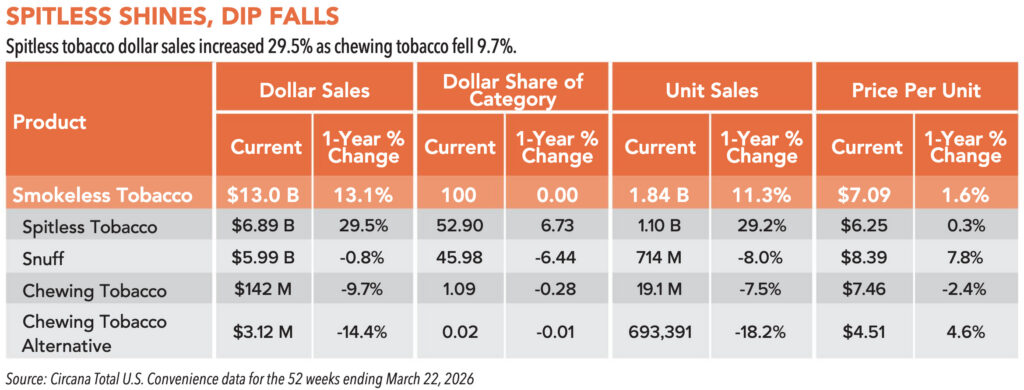
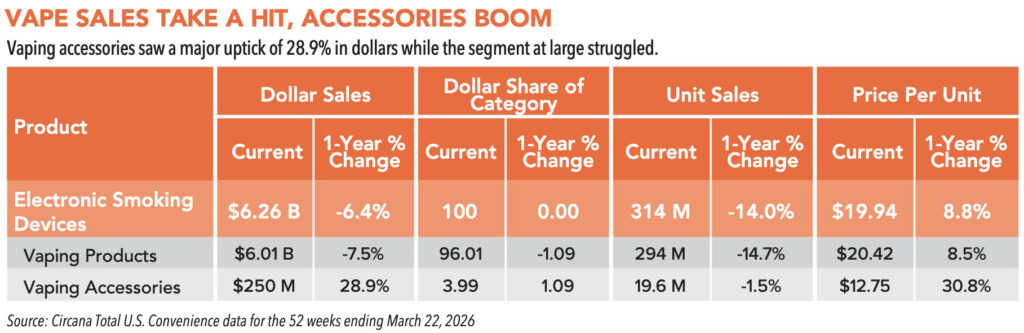
The smokeless tobacco segment, according to recent 52-week data from market research firm Circana, saw a 13.1% increase in dollar sales in the c-store channel compared to last year, and an 11.3% increase in unit sales. Vapes unit sales, on the other hand, dipped 6.4%, while unit sales took a 14% dive.
Traditional cigarettes still accounted for a category-leading $50.7 billion — a decrease of 0.6% compared to last year, with unit sales dipping 5.9%.
Smokeless Success
At Englefield Oil-owned Duchess convenience stores, which operates more than 100 stores across Ohio and West Virginia, tobacco category manager Cal Honabarger noted that the company’s in-store sales are reflecting this shift away from traditional cigarettes to smokeless alternatives.
“We continue to see strong growth within the modern oral nicotine pouch segment, which aligns with broader industry trends,” said Honabarger. “Traditional smokeless tobacco continues to decline year over year, while the vape category appears to have stabilized compared to prior periods after several years of volatility. Overall, consumers are clearly gravitating toward alternative nicotine formats that offer convenience, variety and discreet usage.”
Salem, Ore.-based US Market, which operates 53 c-stores across Oregon, Washington, Utah, Idaho and Texas, is seeing similar results.
“We are seeing consumer demand shift toward modern alternatives, including vape and oral nicotine products,” said Amar Sidhu, director of business development, US Market. “Customers appear to be drawn to products that offer more variety in flavor, format and overall experience compared to traditional tobacco products. Modern oral nicotine products, especially pouch formats, have also gained significant traction due to convenience, discretion and broader flavor options.”
In east Tennessee, Powell, Tenn.-based Weigel’s is also seeing customer preferences shift towards modern alternatives.
“Vape continues to decline for us, traditional smokeless is flat and (nicotine pouches) are continuing to grow at double digits,” said Jessica Starnes, director of loyalty and tobacco category manager, Weigel’s, which operates more than 90 stores in the Volunteer state.
Regulatory Hurdles
Looming in the background, as always, is the possibility of backbar shakeups caused by regulatory interference. On the vape front, the Food and Drug Administration (FDA) has been slowly working through premarket tobacco product applications (PMTAs), but today, only 45 products can be legally marketed in the U.S.
In December 2025, the agency announced that it was aiming to streamline the PMTA process by opening up web-based submissions.
This change has led to measurable progress. In early May, the FDA announced a major milestone for the vape segment — the authorization of its first non-tobacco, non-menthol flavored pods from Los Angeles-based manufacturer Glas. The authorized pods included Mango and Blueberry varieties to be marketed as Gold and Sapphire, respectively.
The defining characteristic of the authorized vapes is the inclusion of age-gating technology, which the FDA believes will effectively curb potential underage usage.
“The FDA’s rigorous, scientific review of these products found that the applicant sufficiently demonstrated that Glas’s device access restriction technology, combined with FDA-required marketing restrictions, is expected to effectively mitigate the ability of youth to use the product,” the agency noted in its statement.
A pressing matter for the industry at large, however, is the illicit vapor marketplace. At NYACS, Ritchie noted that “the vapor category continues to be dominated by illicit disposable products.”
“In New York, Governor Kathy Hochul has proposed vapor enforcement, or directory-style legislation, as part of her budget,” said Ritchie. “While details have not yet been released publicly, NYACS remains hopeful that policymakers will take meaningful action to establish a fair and level playing field for retailers and wholesale partners, while holding bad actors accountable for knowingly supplying illicit products to New Yorkers.”
Flavor bans have also impacted in-store sales across numerous U.S. markets.
“Regulations continue to significantly influence assortment decisions, especially in stores impacted by flavor bans,” said Duchess’ Honabarger. “Locations operating under flavor bans generally generate lower sales volume because they lack the assortment many consumers want.”
US Markets’ Sidhu mentioned that federal and state regulations play a major role in how the chain manages its category and product assortment.
“Compliance is a priority, and we are careful to ensure that any products we carry meet applicable regulatory standards,” he said. “We also work closely with trusted suppliers and industry partners to stay informed and make responsible assortment decisions.”
Building the Backbar
With state and federal regulations still largely up in the air, determining which products and SKUs to focus on becomes essential for retailers looking to maximize tobacco profits while staying in compliance. Keeping a close eye on the backbar and shifting preferences will be the key to unlocking tobacco success in 2026 and beyond.
“We closely monitor rate of sale, weeks of supply, productivity per facing and overall category trends when making assortment decisions,” said Honabarger. “Those metrics help determine where additional facings or brand extensions are warranted and where underperforming SKUs should be reduced or eliminated. In recent years, the pace of innovation within nicotine products has accelerated, so we’ve had to become more agile and data-driven in evaluating assortment changes.”
Agility, as Honabarger said, is the name of the game when it comes to backbar optimization. Retailers need to be adaptable and quick to pivot when regulations hit or consumer preferences inevitably shift, which is an occurrence that has become more common in recent years.
“Our process has become more disciplined in recent years,” said Sidhu. “We evaluate SKUs based on customer demand, compliance, brand reputation, supplier reliability, sales performance, margin and category balance. We also value long-term vendor partnerships and avoid adding products solely because they offer higher margins. Protecting the integrity of our stores and our customer trust remains the priority.”
Potential Roadblocks
Looking ahead, the tobacco category will face scrutiny from a few different angles. As previously mentioned, the illicit market remains a key point of concern for both retailers and legislators, and will likely inform many of the decisions made from a policy standpoint.
“The most pressing challenges for retailers remain the proliferation of illicit products and the impact of poorly structured legislative policies,” said NYACS’ Ritchie. “While segments such as vapor and nicotine pouches show strong growth potential, there is concern that policy decisions in Albany could hinder that progress.”
Weigel’s Starnes agreed, noting that “the largest issue is illicit vapor in (their) trading area.”
But, that’s not the only concern. The rate of evolution and progression within the tobacco space continues to be a challenge for retailers looking to stay profitable and compliant.
“In addition to normal operational challenges, the rapid evolution of the nicotine category requires constant adjustment at the store level,” said Honabarger. “We are actively developing new planograms and resetting tobacco fixtures to better align with changing consumer trends and the growing importance of modern oral nicotine products.”
Sidhu said that the main challenges US Market is facing within the category now include theft prevention, returns, product verification, vendor management and ensuring proper documentation from distributors.
“We are focused on working only with reliable suppliers and maintaining compliance with all required certificates, distribution standards and legal requirements,” he said. “… A great deal of care goes into managing this category responsibly. While margins can be attractive, we believe it is important to be selective, compliant and brand-conscious when deciding which products enter our stores. Long-term business reputation, customer trust and responsible retailing matter more than short-term margin opportunities.”