Price awareness, strict inventory management and localized assortment are the keys to category success for cigarettes and cigars. In recent years, combustibles have seen unit sales fall to nicotine alternatives, high taxes and health concerns, although many states are now imposing excise taxes on tobacco products such as vape and nicotine pouches, too.
Still, cigarettes are sitting at $50.8 billion in sales for the year ending Sept. 6, according to market research firm Circana.
“While cigarette volumes have experienced a long-term decline, cigarettes remain one of the most important categories in convenience retail. For many stores, cigarette sales continue to drive valuable customer traffic and contribute significantly to overall store sales,” said Alison Ritchie, president of the New York Association of Convenience Stores.
Category Management
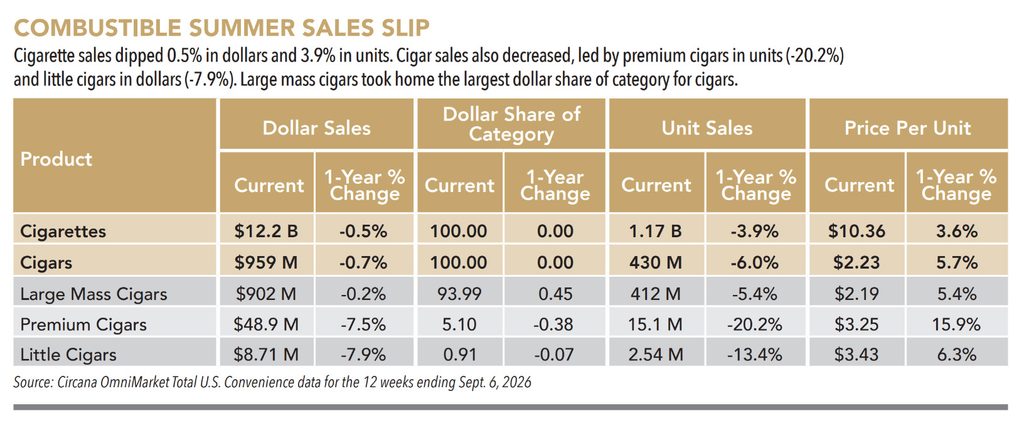
While cigarette dollar sales have essentially garnered zero net change (up just 0.1%) in the 52 weeks ending Sept. 6, cigars have increased a slightly larger 0.4% in dollars. Both jumped in price per unit (5.1% and 6%, respectively).
Hot Spot Convenience Stores, operating over 40 locations in North Carolina and South Carolina, has been focusing on streamlining and optimizing its cigarette assortment to better align with evolving consumer purchasing habits.
Premium brands are still the majority of sales, but “the most notable shift has been increased demand for value-priced products as consumers manage higher living costs and inflationary pressures,” said Shawn Holmes, corporate marketing and merchandising manager for Hot Spot.
Many of the chain’s rural locations over-index in traditional cigarette sales, while stores in growing markets and areas with younger demographics yield stronger performance in nicotine pouches and alternative nicotine products.
“One of the biggest lessons we’ve learned is that a one-size-fits-all assortment rarely delivers the best results. We rely heavily on store-level sales data, customer purchasing patterns and local demographics to tailor assortments,” said Holmes. “Our strongest performing tobacco locations are typically those where the assortment reflects the unique needs of that trade area rather than a chain-wide average.”
Ritchie agreed. She noted that retailers should regularly evaluate category performance at the store level as demand can vary significantly by market, and the most-effective strategies are tailored to local buying patterns.
The right product mix, she said, is critical.
According to Holmes, tobacco remains one of the most localized categories in convenience retail.
“Adult consumers expect stores to carry the products they purchase most frequently, whether those are premium brands, value offerings or other nicotine products,” Ritchie added.
The cigar segment at Hot Spot continues to become more segmented and opportunity driven. Traditional value cigars are an important part of the business, but larger formats, premium offerings and flavored products (where regulations permit) are also seeing stronger demand.
There is also increased crossover between cigar users and other nicotine categories at Hot Spot.
“Today’s cigar customer is often looking for either affordability or a more premium experience, depending on the occasion,” Holmes said.
And for those customers looking for affordability, value perception is critical.
Hot Spot strategically prices its set rather than implement broad price increases. The chain also uses promotional offers, multipack deals and clearly communicated value proposition to entice customers.
“Shoppers are willing to pay more when they recognize the value in the product, but they are also quick to change purchasing behaviors when prices move beyond their comfort level,” said Holmes.
When considering its cigarette and cigar assortment, manufacturer programs are also an important part of category management; they support price competitiveness, merchandising opportunities and overall profitability.
“That said, our primary objective is maximizing total category performance and customer satisfaction. We evaluate programs based on their ability to drive sales, improve margins, create value for the customer and support long-term category growth,” Holmes said. “The best partnerships are those where manufacturer objectives align with our goals around pricing, execution, inventory management and shopper engagement. Ultimately, the customer drives our decisions, and every program must support that priority.”
The best stores, Holmes said, maintain strong in-stock conditions, competitive pricing and a balanced assortment. Strong compliance also plays a critical role in success.
“The stores that consistently outperform are the ones that combine data-driven decisions with excellent day-to-day execution,” Holmes said.
Ritchie added that maintaining a clean backbar is also important, as is training employees to understand age-verification procedures and regulations, including licensing requirements, product restrictions and local ordinances.
Ritchie added that generally, successful retailers are taking a broader view of the nicotine category. They are also using data to understand category performance and training employees on
In all, Holmes and Ritchie agree that retailers should know their trade area, use data to guide decisions, pay attention to the broader nicotine landscape, and stay disciplined with pricing, compliance and store execution.
“Cigarettes remain an important traffic and sales driver for convenience stores, but the category continues to evolve. Success today requires balancing traditional tobacco products with emerging nicotine alternatives, tailoring assortments to local consumers, maintaining competitive pricing and staying ahead of regulatory and market changes,” Holmes said.
Regulation Breakdown
While c-store retailers are strategizing for assortment, pricing and inventory management, they’re also monitoring regulations.
New York is considering a generational tobacco ban that would limit tobacco purchases to those born before Dec. 31, 2007. If it passes, it would be effective Jan. 1, 2028.
“From a retailer perspective, the proposal raises significant concerns. Convenience store owners could face increased compliance burdens, customer confusion and more complicated age-verification requirements,” Ritchie said.
If retailers need to enforce a generational distinction at the point of sale, negative interactions with store personnel might ensue. It raises legitimate security concerns, she added.
For regulatory issues in general, retailers must stay engaged and informed.
“Regulatory changes have become one of the biggest factors impacting tobacco category management,” Holmes said.
Hot Spot’s approach is to stay educated, remain compliant and build enough flexibility into its assortment strategy to quickly adapt.
Flexibility remains one of the industry’s greatest strengths, Ritchie noted.
Convenience stores have long understood the need to adapt to the changing regulatory environment. While new products rapidly enter the market and state and local legislative bodies continue to pressure the convenience store landscape in many places, efficiency and adaptability have always been key c-store tenets.
“Retailers should make their voices heard. Convenience stores are often small businesses that serve local communities, employ local residents and contribute to the state economy. Policymakers need to understand how proposed regulations affect legitimate businesses and the consumers they serve. Engagement in the legislative process has never been more important,” Ritchie said.