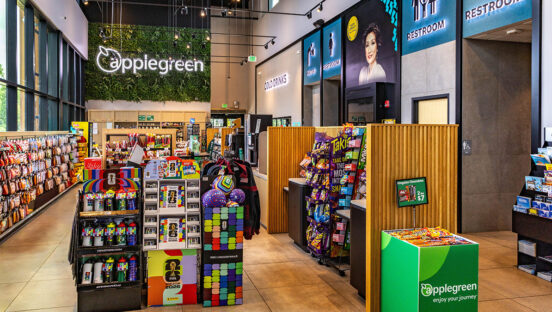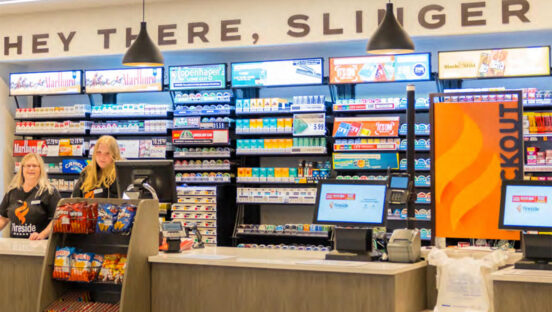
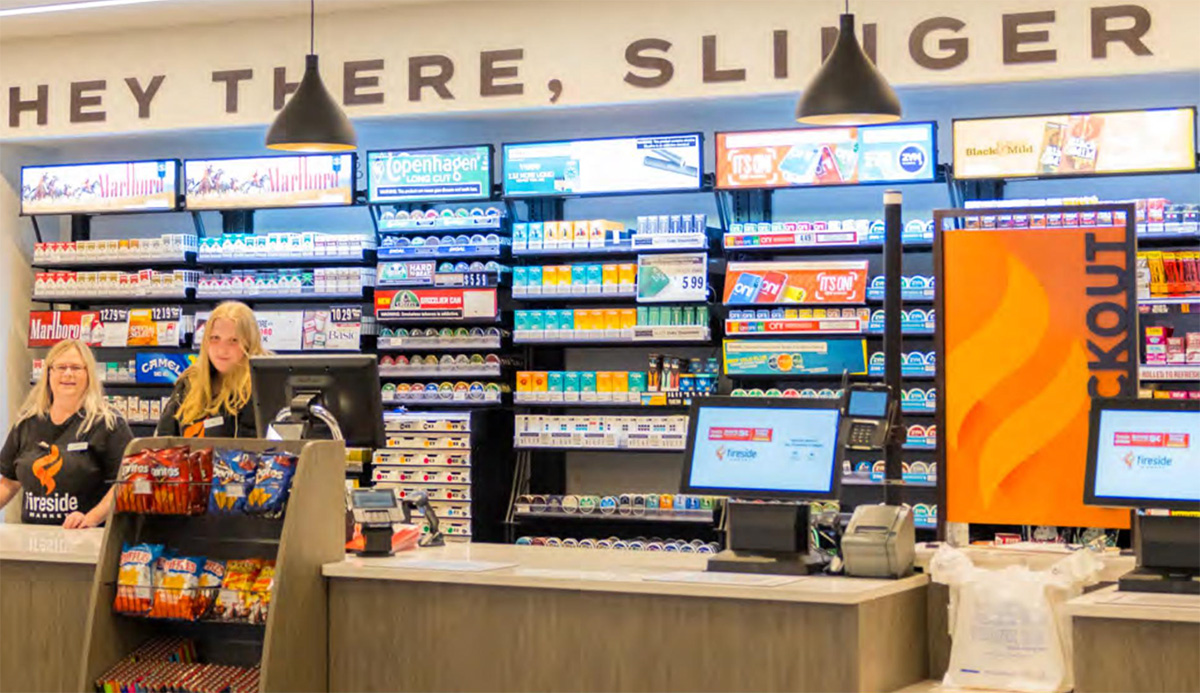
When designing the backbar for the six new stores Yatco Energy opened last year, Director of Category Management & Merchandising Anna Bettencourt shuffled emphasis, placing modern oral nicotine pouches front and center and allocating less real estate to traditional smokeless and vape. Yatco currently owns and operates 17 convenience stores throughout Massachusetts as well as one site each in Connecticut and Rhode Island.
“We also will replace older fixtures in stores this year to better accommodate how tobacco and nicotine products will perform in today’s environment,” Bettencourt added.
Category managers across the country have made similar decisions regarding planogram strategies in recent years, and it’s a trend that probably will continue as the tobacco/nicotine category undergoes further metamorphosis due to regulatory actions and evolving consumer behaviors. Figuring out those strategies for 2026 requires thorough examination of each product segment’s recent production.
Economics Boost Discount Cigarettes
2025 Review: Sales volume of combustible cigarettes continued to fall last year; however, according to the Goldman Sachs Nicotine Nuggets survey of approximately 40,000 tobacco retail sites, that dip softened slightly during the third quarter: -5.7% versus -7.7% for the preceding three months. Why the adjustment? Analysts point to downtrades.
“Ongoing economic pressures are stretching household budgets and forcing trade-off decisions at the shelf. As a result, lower-tier, value-priced brands continue to capture share by offering a viable alternative to premium offerings, which have seen notable price increases,” said Joseph Bortner, senior category manager for York, Pa.-based Rutter’s, which operates 93 locations in four states.
Circana market research of the convenience store channel indicated cigarettes’ price per unit climbed by nearly 6% for the 52 weeks ending Dec. 28, 2025. Ironically, the shift away from premium has paid off for some c-stores.
“Since coming off the everyday low price program last year, we have seen double-digit growth in our cigarette category, and all our growth is from fourth-tier cigarettes,” said Sean Bumgarner, VP for Scrivener Oil Co. which has 12 Signal Food Stores in Missouri.
2026 Outlook: Per the Nicotine Nuggets assessment, c-store cigarette sales most likely will have a repeat performance this year. Analysts anticipate volume to lessen again and economic conditions to further push price gaps between premium options and lower tiers.

Modern Oral Momentum
2025 Review:Once again, the modern oral nicotine segment, specifically nicotine pouches, outperformed most of the other tobacco/nicotine category product lines. Circana reported dollar sales throughout last year grew by nearly 30% and units jumped by more than 25%. Goldman Sachs highlighted promotional efforts by manufacturers as key to some of the growth. More than three-quarters of retailers responding to the Nicotine Nuggets survey cited campaigns, such as a free pouch with purchase of any nicotine item, for attracting new customers to the alternative.
“The nicotine modern oral (NMO) category in our stores is continuing its impressive growth. We have expanded the space for this category, but only (four) brands, ZYN, Velo Plus, ON! and Rogue, move significant volume for us,” said Bumgarner.
“Growth is being fueled by expanded milligram levels and flavor innovation, giving consumers a wide range of options,” added Bortner.
2026 Outlook: The pace of Food & Drug Administration (FDA) Premarket Tobacco Product Application (PMTA) determinations for synthetic nicotine products remains a top concern for the c-store industry. Although some products have received authorization to be sold, dozens more are still pending despite a pilot program the agency launched last fall aimed to restructure and speed up the review process.
“What is interesting is that many brands are on the approved state directory list in Massachusetts, but because the FDA has not given some of these products in the modern oral category authorization, we cannot sell them in some local municipalities,” said Bettencourt.
“State directories have been helpful in some places. They offer a workaround for businesses that are not getting good information from the federal government. However, there is still inconsistency from state to state, and that can make it difficult for stores,” added Doug Kantor, general counsel for the National Association of Convenience Stores (NACS).
Also, a leading manufacturer recently submitted modified risk applications to the FDA for its pouches, hoping to reserve the right to be marketed as less harmful. That said, it’s difficult to predict when that review will conclude.
“The lack of information until decisions are made makes it hard to know exactly what types of products are applying for (modified risk classification) and where they are in the process,” said Kantor.
Vape’s Black Market Battle
2025 Review: “Demand for vape products was flat for us in 2025. We used some of the vape space to expand on NMO, which helped increase the sales of that category,” Bumgarner noted.
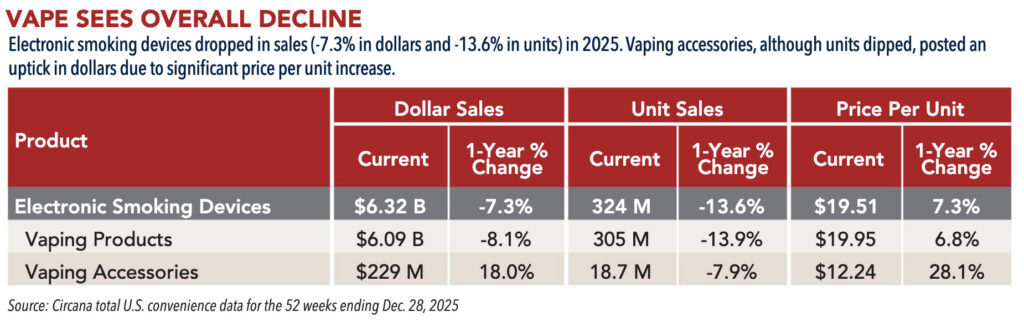
Circana found dollar sales of vaping products were down by 8.1%, and even though units totaled more than $305 million, the product lines fell off approximately 14% in volume for the 52 weeks ending Dec. 28, 2025.
2026 Outlook: Vape and e-cigarettes also felt the sting of stalled PMTA decisions for another year; however, while the industry awaits FDA announcements, manufacturers have innovated with various technologies. Vaping devices now feature options such as Bluetooth connection or intelligent processors controlling power and temps. These features enable users to customize their experience.
At the same time, the vape sector faces upticks in illicit products. While Kantor noted enforcement activity has picked up on finding and removing contraband at the point of import, the black market continues to thrive.
“It would be helpful if enforcement was done in concert with (PMTA decisions) so good actors in the industry know when they’re doing the right thing and when they aren’t doing the right thing,” he added. “Then, once we know what products are allowed, a strong enforcement is necessary and makes sense. The other thing to watch for this year is counterfeit products, especially on pouches. Retailers should be wary and working with reputable distributors so they don’t get counterfeit product.”
Smokeless & Poly-Use Preference
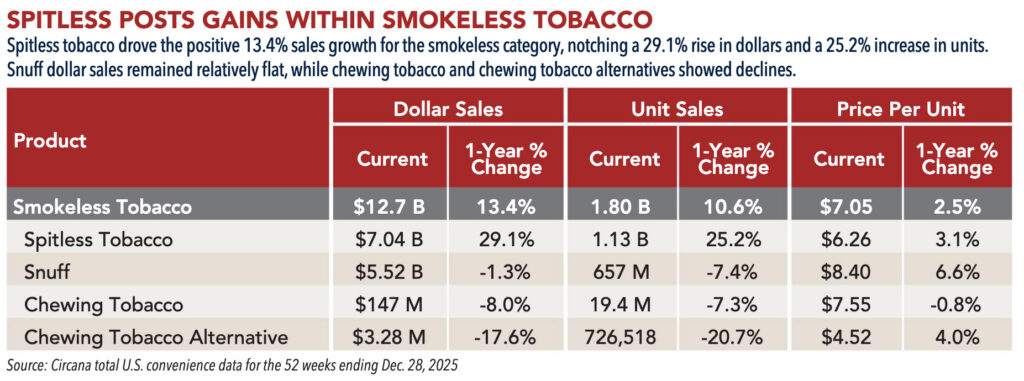
2025 Review: Overall, the smokeless tobacco element gave up market share to modern oral last year. Per Circana, snuff lost 6.45 of dollar share, but remains No. 2 in the segment. Chewing tobacco pretty much maintained its position, but dollar share pales in comparison to spitless. However, Bumgarner sees a benefit of consumers combining nicotine purchases.
“We had more poly-use, traditional smokeless users also purchasing NMO products than in previous years,” he explained. “Also, due to strong multipack offers, traditional smokeless products were up slightly for us in 2025.”
2026 Outlook: Most industry watchers anticipate a similar environment for chewing tobacco and snuff throughout the rest of this year. Of course, new state and local regulations may hamper sales for this and other segments within the tobacco/nicotine category. For example, on Jan. 1, Washington state enacted a new excise tax of 95% of wholesale price on the sale of tobacco/nicotine products, which ties it with Minnesota as one of the highest state rates, per the National Association of Tobacco Outlets.
Cigars: Escaping Tariffs
2025 Review: This time last year, there was plenty of uncertainty on how tariffs would affect cigar imports. Looking back, imports of premium brands actually increased for at least the first half of the year, reported Cigar Aficionado.
“Tariffs did impact certain imported cigar products, but the overall effect was less disruptive than many initially projected. Our scale and long-standing supplier relationships allowed us to mitigate cost pressures through advance purchasing, strategic sourcing and thoughtful assortment adjustments,” said Jeremy Weiner, category director of cigars and premium products for Smoker Friendly. The Colorado-based company is part of the family of stores owned by The Cigarette Store Group, which includes Tobacco Depot, Smoke ‘N Go, Havana Manor and Gasamat retailers.
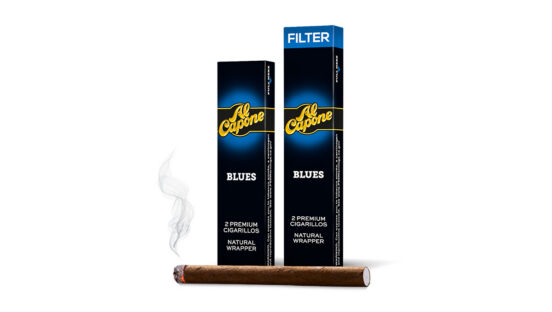
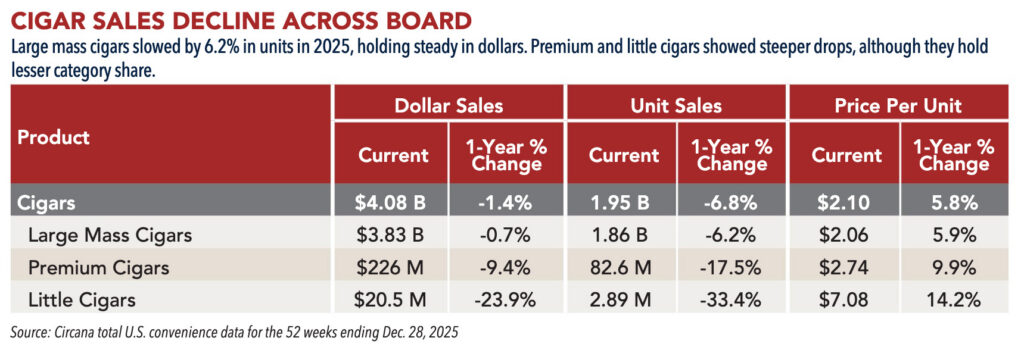
But high-end cigars represent a small portion of the subcategory sold in convenience stores. Rather, mass-produced cigars and cigarillos, or small cigars, combine for almost 95% of dollar share in the c-store channel, per Circana, and each classification experienced downturns. Little cigars registered the biggest falloff: almost 24% in dollar sales and more than a one-third drop in units.
“Cigarillos remain one of the most regulation-sensitive product lines I manage. Flavor bans — particularly at the state and local level — have reduced availability in certain markets, but consumer demand has not disappeared,” said Weiner. “Where flavored products are permitted, cigarillos continue to perform well and drive traffic, especially among value-conscious adult consumers.”
2026 Outlook: Like so many products, cigars are competing with the popularity of pouches. Weiner anticipates adjusting backbars to accommodate the current status of consumer preferences. And of course, he’s waiting for FDA and state lawmakers’ decisions on possible further flavor restrictions.
“The growing patchwork of regulations remains one of the biggest challenges for retailers, as it directly impacts assortment planning and in-store execution. Our focus is on staying proactive — working closely with our compliance teams, suppliers and operations partners to ensure Smoker Friendly remains agile, compliant and well positioned to serve adult consumers,” he said.
Tobacco Accessories: Holding Ground
2025 Review: Tobacco accessories added nearly $585 million to the c-store channel last year. Cigar accessories, according to Circana, led in dollar sales with gains of approximately 18% and an almost 10% jump in unit sales.
“While still a relatively small segment, accessories — particularly wraps — have shown steady growth and increasing consumer interest,” Bortner noted.
2026 Outlook: Most category managers don’t expect this sector to pick up much steam but hope customers find the convenience of c-stores stocking lighters, papers and other accessories worthwhile, even if the prices keep inching upward.
“This category often flies under the radar, but maintaining a thoughtful, curated assortment is important. A broad selection isn’t necessary, but having a presence in this space is essential to avoid missed opportunities,” advised Bortner.

CBD: Recalculating Offerings
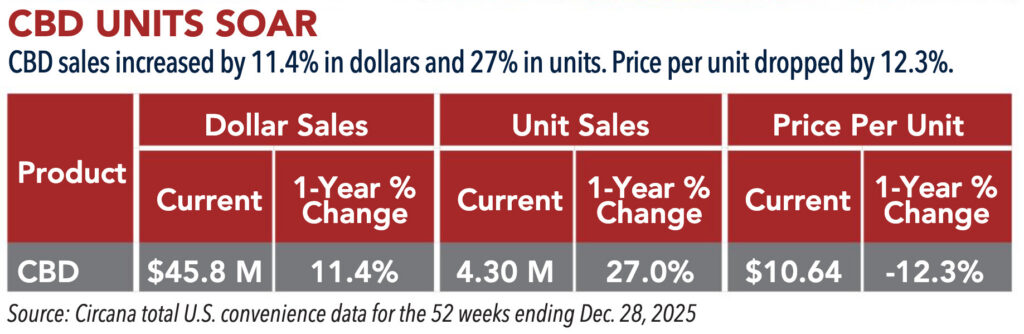
2025 Review: According to Circana data, cannabidiol (CBD) sales in c-stores grew by more than 11%, but specific product options had varying results. Last year, consumers gravitated toward carbonated beverages, alcohol, cocktail mixes, hard seltzers and cigarettes containing cannabidiol elements. Sleeping aids, smokeless tobacco, tobacco accessories and vitamins each slipped in dollar sales.
2026 Outlook: Thanks to language in the Continuing Resolution and Appropriations (CR) bill passed last November, manufacturers may have to reformulate their CBD products by this coming November. The change in the law states hemp products must be defined by total tetrahydrocannabinol (THC) rather than exclusively by delta-9 THC, which has been identified as the primary psychoactive agent in cannabis.
“We’re working (with lawmakers) to try to get clarity and seek more reasonable limits on THC content or to get a delay of the effective date to give the time needed to work out the right way to regulate products,” said NACS’ Kantor.
Prior to the CR passage, Bettencourt contemplated adding a variety of CBD/hemp options to stores, but for now, she’s holding off until further clarification.
“I feel like it’s a viable market as a whole, but the government needs to revisit it,” she said. “Stores will have to change their assortment and bring in what is allowed, but not necessarily what the customer wants, if this goes into effect.”
While certain product lines within tobacco/nicotine likely will continue to feel the effects of encroaching regulations, the category remains a top producer for c-stores, totaling over $74.3 billion in 2025. CBD added another $45.8 million. Keeping tabs on developing trends allows stores to focus on satisfying customer demand and experience, thereby evolving the category.