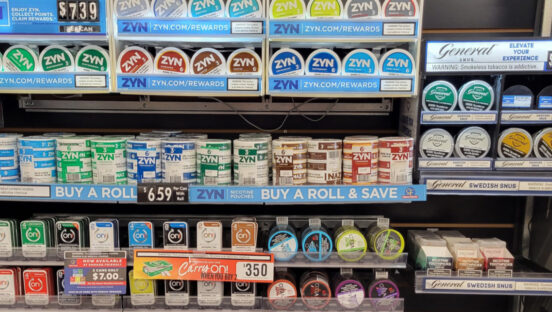

As one of the driving factors in backbar management, c-store operators are monitoring federal, state and local legislation extensively, even contacting their representatives and participating in outreach when necessary.
In Massachusetts, for example, some cities have implemented a generational nicotine ban, whereby anyone born on or after a certain date can never legally purchase nicotine products.
Brookline, Mass., was the first U.S. city to pass this mandate (in 2020), stipulating that tobacco and nicotine products cannot be sold to those born on or after Jan. 1, 2000.
Members of the New England Convenience Store and Energy Marketers Association (NECSEMA) challenged the ban, but it was judged constitutional and upheld in 2024, “because Massachusetts has unique Home Rule and gives wide deference to towns,” said Peter Brennan, executive director of NECSEMA. “And we also have unique powers granted through various case law over the years to local health boards. So, in Brookline, they did it via town meeting.”
Since then, 21 additional towns have adopted tobacco-free generation laws.
A statewide bill was attempted this year, and, fortunately for nicotine users, it has not made it out of committee.
“We found that once we were organized and we were ready to deal with this, the best way to get people opposed to it was just to let them know what it actually does, because the advocates will claim this is to eliminate or reduce youth smoking, youth tobacco usage. That’s not what it does at all. It bans adults from purchasing legal nicotine products,” said Brennan.
In the meantime, should it pass, the illicit market grows, as do sales in neighboring states such as Rhode Island and New Hampshire.
Brennan noted this has been the case with flavored tobacco products, which Massachusetts banned in 2020.
“They’re still being consumed in Massachusetts. Massachusetts is just not receiving the excise tax money on that or the sales tax anymore, and Rhode Island and New Hampshire are very happy to receive that instead. So, the market shifts. … It just shifts the sales into the illicit market, across state lines; when it’s a municipal ban, then it just shifts it to the next town over,” he said.
As for the nicotine-free generation policies, activism on the part of NECSEMA, retailers and members of the public garnered a few wins, whereby some towns have rejected the policy.
The policy, beyond halting certain sales, also would affect point-of-sale systems, age verification systems and business valuation.
Even among Massachusetts cities that have not instituted the policy, merchandising nicotine given the statewide flavor ban has been frustrating, as what each town considers flavored is different.
“It’s almost impossible to keep up with,” Brennan said.
Massachusetts might be one of the most regulated states in the tobacco and nicotine space, but it is not the only one.
“State regulation has become a defining backdrop for the tobacco category,” said Tina Badger, category manager for CrossAmerica Partners LP, which operates 345 stores. “Rather than episodic disruption, it now operates as a permanent environmental constraint — quietly but consistently influencing how the category is structured, how space is allocated and how portfolios evolve over time. The result is less about managing individual changes and more about navigating a long-term redefinition of what a viable tobacco set looks like.”
CrossAmerica stores are located in 18 states, including Massachusetts, obliging the chain to keep well abreast of state-level legislation.

Other states in which the chain is located that have, at press time, introduced or taken action on a recent tobacco bill include Ohio, which introduced a bill that proposed modification to the regulation, registration, licensure, inspection and enforcement of electronic smoking, tobacco, nicotine and vapor product retailers; and New York, which introduced a bill requiring retailers to offer at least one nicotine replacement therapy product approved by the FDA and is undergoing budget negotiations for a wholesale tax on nicotine pouches, fee on vapor products and vapor product registry on which manufacturers must pay to be included.
Federally, the FDA revealed in May that it will not prioritize enforcement of vapor and nicotine pouch products marketed without authorization if there are certain pending applications and if, for flavored vapor products, the application includes data necessary to evaluate whether it’s appropriate for the protection of public health.
The FDA is still targeting illicit products, however, and this new enforcement guidance would not apply to products with elements that would appeal to youth or that have significant safety concerns.
The FDA intends to create a webpage identifying products that would be covered in the new guidance.
Additionally, the FDA removed the queue for applications pending Acceptance Review, allowing premarket tobacco product applications to almost immediately enter the first phase of application review, among other measures to establish greater efficiency in the review process.