Technological advancements are barreling ahead in 2026, with artificial intelligence (AI) impacting the way companies do business across industries. Savvy c-store retailers are paying attention, piloting solutions and asking how AI might help them solve specific pain points. But even if your convenience store chain isn’t integrating AI capabilities today, it’s likely to still be impacted by the way AI is beginning to influence shopper behaviors and expectations overall in the very near future.
At the end of 2025, Forbes pointed out that retail was entering “the first real phase of agentic AI commerce” in 2026. In other words, AI can now search for, compare and purchase routine items for shoppers like snacks, drinks and household products, which could begin to challenge neighborhood convenience retailers’ traditional advantages of location, impulse purchases and speed. Forbes also pointed to hyper-personalization among its list of defining trends for 2026. The convenience store industry is already moving in this direction, with operators leveraging increasingly sophisticated data to deliver more precise, behavior-driven loyalty offers and promotions.
Deloitte’s 17th Annual Tech Trends report noted that AI is moving “from experimentation to impact.” Essentially, companies are rebuilding workflows and systems from the ground up to better take advantage of how AI can drive results. AI is also helping businesses to integrate their traditional back office, front office and digital offerings. The report predicted that we’ll begin to see a trend of AI moving “from screens to streets” as robots “begin to navigate human spaces.” Already we’re seeing delivery robots and autonomous vehicles being piloted in certain areas of the country. Not to mention autonomous floor cleaners and checkout-free stores, just to name a few examples.
The takeaway is that the tech landscape is shifting quickly, and that’s challenging companies to rethink how they operate in both big and little ways.

Here Comes AI
At Friendly Express, which operates 38 convenience stores in Georgia, “AI-monitoring operations in the stores” is one of the biggest tech trends Amy Wood, director of enterprise IT, is watching. The chain is in the early stages of adopting AI across the business.
“Early on, we tested an AI solution focused on foodservice monitoring, but it did not ultimately deliver the results we were looking for based on our specific goals. That said, we believe we were early in the process, and rather than being discouraged, we have viewed it as a valuable learning experience,” Wood said.
More recently, Friendly Express has started employing AI in “more practical ways to support operations and marketing, including analyzing data, helping retrieve information more efficiently, and refining existing code and queries to better access the data we need,” Wood further explained.
In 2026, Friendly Express is focusing its approach to AI on “learning, testing and identifying the areas where AI can create the most value,” Wood said.
At Lassus Bros. Oil Inc., with 35 c-stores in Indiana and Ohio, AI-powered solutions to monitor safety, security, customer service and store conditions in real time is the biggest tech trend on the company’s radar.
“Our approach to AI today is practical and focused on productivity,” explained Brittany Wilchar, director of sales & marketing for Lassus Bros.
The convenience store chain is currently exploring how AI can help with marketing content creation, data analysis and operational planning.
“For a small but growing marketing team, tools that help streamline content creation, analyze performance data and identify trends allow us to move faster and be more strategic,” Wilchar said. “We view AI as a tool that supports our team rather than replacing it, helping our people spend more time on strategy and less time on repetitive tasks.”
Sanjit Bajimaya, director of IT for Loop Neighborhood Market, which operates 156 c-stores in California under the Loop Neighborhood Market and Poppy’s Market banners, is watching the aforementioned agentic AI trend unfold. At store level, Loop is rolling out generative AI, i.e., AI that can generate text, images, code or other content based on prompts, for standard operating procedures and for question-and-answer applications.
“We have some form of AI in data; still progressing though,” Bajimaya added.
Payments & Personalization
While AI is making a major impact and is widely seen as today’s most important emerging technology, it’s far from the only technology influencing convenience store operations today.
Other big tech trends on Bajimaya’s radar, for example, include payments and store operations automation.
“For payments, we are looking into mobile payments, ACH (Automated Clearing House), loyalty payment, speed of processing, etc.,” he added.
On the automation end of the tech spectrum, Loop is currently testing Mashgin self-checkout kiosks. It also rolled out car wash subscriptions two years ago and is seeing good adoption from customers.
At Lassus Bros. stores, Wilchar is monitoring trends in frictionless checkout, digital loyalty ecosystems and personalization. Over the past year, the convenience store chain has been heavily focused on expanding its digital loyalty ecosystem through its LassusGo Rewards program.
“We are shifting away from physical loyalty tags and are focused on increasing digital registration and engagement,” Wilchar said. “This allows us to communicate with customers through push notifications, personalized offers and targeted promotions. While still early, we’re seeing stronger engagement from loyalty users and improved promotional performance.”

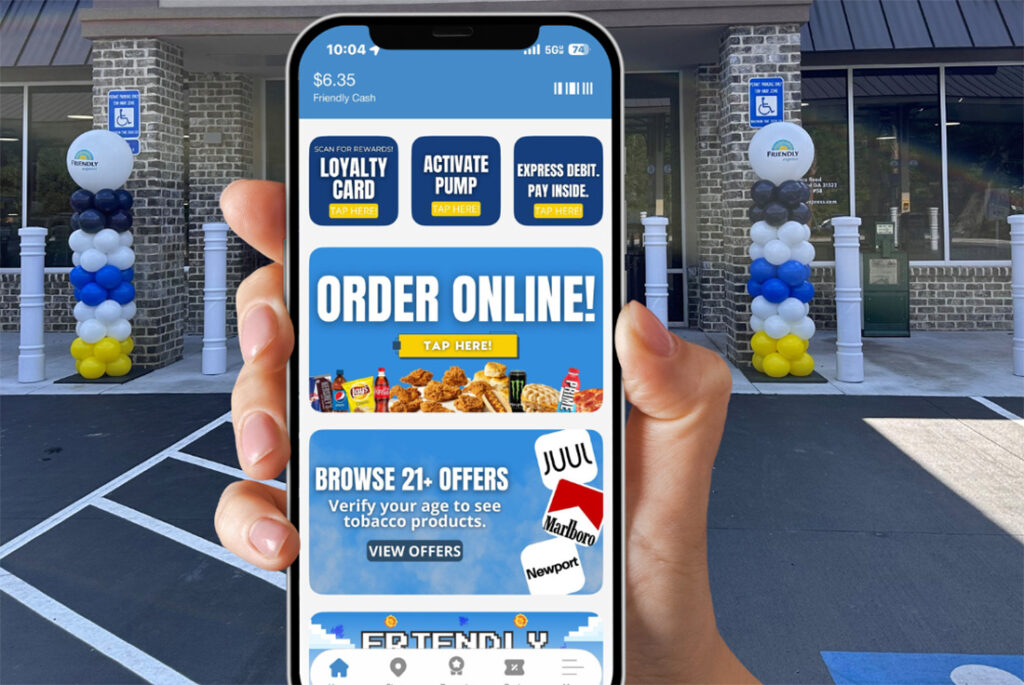
Loyalty personalization is also a key trend that Wood is paying close attention to at Friendly Express.
“We added online and mobile ordering to offer more convenience to our customers. While it has not taken off as much as we expected, it has given us a good foundation to build on, and we are looking at additional ways to increase usage,” she explained. “We also launched a new mobile app this year. We have been able to increase engagement and offer personalized offers to our customers and our employees.”
The Rise Of Retail Media
Retail media is also in the top three tech trends that Wood has her eye on this year. Friendly Express has begun building out its retail media network capabilities, having deployed DX Promote, a digital content and media management platform for fuel dispensers, across all of its locations. Many stores also feature digital boards, including new digital boards inside the stores.
“These tools allow us to connect with customers throughout their visit, highlight our brand and feature exclusive promotions and offers,” Wood said. “We see this as an important part of our continued growth and customer engagement strategy.
Lassus Bros. is also starting to build the foundational capabilities to support a comprehensive retail media network.
“Through our loyalty platform, Lassus Radio and digital marketing channels, we are able to provide targeted promotional opportunities for business partners, including in-app promotions, push notifications and in-store marketing support,” Wilchar said. “As our loyalty base and tech stack continues to grow, we see potential to expand these capabilities even more in the future.”
Loop Neighborhood is using digital platforms like TVs and its mobile app as retail media. “We have been using it for a year and seen good response from the vendors,” Bajimaya said.
Data Strategies Evolve
As technology advances, convenience store operators are reevaluating their data strategies to ensure they’re gathering clean, useful data that can help them offer more targeted experiences now or in the future.
“Our approach to data has evolved from simply gathering information to focusing more on how to make it useful,” Wood said. “Like many organizations, we can sometimes feel overwhelmed by the amount of data available, so we are increasingly focused on identifying what matters most.”
Wood added that the most valuable data to Friendly Express currently is any data that can help the c-store chain improve operations, marketing and customer understanding.

“We are also beginning to use AI tools to help filter through that data and determine how to apply it more effectively across the business,” she said.
Loop Neighborhood considers itself a data-forward company. “We have evolved to looking at near-real-time sales information,” Bajimaya explained. He added that the chain’s “decision tree” is built on the data. “We have created a data lake to normalize data from different sources.”
Lassus partnered with a c-store retail analytics and consulting company to “enhance data analytics capabilities and put actionable insights directly into the hands of our managers and operations teams through the (partners’) portal and real-time scoreboards,” Wilchar said. The partnership has allowed Lassus to move past static reporting into daily performance management.
“Our teams now have visibility into key KPIs (key performance indicators) such as sales, category performance and operational metrics in a way that is simple, consistent and easy to act on,” she said.
The move has also been valuable in developing leaders because it creates accountability and clarity around expectations and provides managers with the information they need to take ownership of their role.
“Ultimately, this has strengthened our ability to drive consistent execution across stores while building a more data-driven culture throughout the organization, she added.
As technology continues to reshape convenience retail, operators who embrace AI, retail media and data-driven personalization are expected to be the best positioned to engage customers and grow profits.
Staying ahead of these emerging technology trends isn’t an option anymore, because technology is moving ahead with or without your buy-in and shaping customer expectations and behaviors at a rapid rate.
A strong tech stack is becoming the blueprint for success across industries and is expected to be a core part, if not the very foundation, of the modern convenience store for the future.