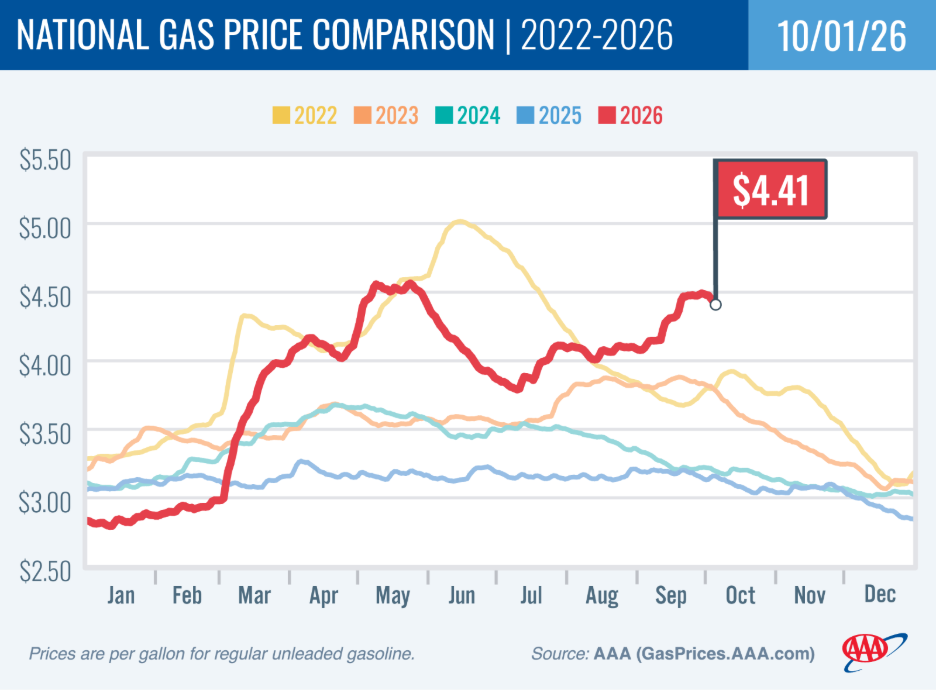
Following a record-setting September at the pump, the national average for a gallon of regular gas dropped nearly seven cents from last week to $4.41, according to a report from AAA.
The monthly average in September was $4.33, 50 cents higher than the previous September record of $3.83 set in 2023. Crude oil prices have dipped back into the $90 per barrel range, lowering the national average, but overall gas prices remain the highest they’ve ever been for this time of year.
According to new data from the Energy Information Administration (EIA), gasoline demand decreased last week from 8.84 million barrels per day to 8.68 million. Total domestic gasoline supply decreased from 206 million barrels to 204.4 million. Gasoline production also decreased from 9.59 million barrels to 9.46 million per day.
At the close of Wednesday’s formal trading session, WTI rose $1.04 to settle at $90.42 per barrel. The EIA reports that U.S. crude oil inventories increased 0.9 million barrels to 427.3 million barrels, 2% above the five-year average.
The national average per kilowatt hour of electricity at a public EV charging station stayed the same this past week at 42 cents.
Gas
The nation’s top 10 most expensive gasoline markets are California ($6.40), Hawaii ($5.62), Washington ($5.49), Nevada ($5.49), Oregon ($5.05), Alaska ($5.03), Utah ($4.97), Idaho ($4.97), Arizona ($4.77), and Illinois ($4.71).
The nation’s top 10 least expensive gasoline markets are Indiana ($3.81), Texas ($3.94), Georgia ($3.96), Mississippi ($3.96), Louisiana ($3.97), Tennessee ($3.97), South Carolina ($3.99), Arkansas ($3.99), Alabama ($4.02), and Kentucky ($4.04).
Electric
The nation’s top 10 most expensive states for public charging per kilowatt hour are Hawaii (54 cents), West Virginia (52 cents), Louisiana (49 cents), Alaska (48 cents), California (48 cents), New Hampshire (47 cents), New Jersey (45 cents), North Dakota (44 cents), Arkansas (44 cents), and Arizona (44 cents).
The nation’s top 10 least expensive states for public charging per kilowatt hour are Kansas (31 cents), Missouri (32 cents), Iowa (33 cents), Nebraska (34 cents), Maryland (35 cents), South Dakota (35 cents), Utah (35 cents), Vermont (35 cents), Minnesota (37 cents), and New Mexico (38 cents).
Advice for Retailers
Elie Y. Katz, CEO and president National Retail Solutions (NRS), recently wrote an article for CStore Decisions titled, “Price Pain at the Pump, Not at the Register,” in which he outlined three pieces of advice for c-store retailers dealing with increased gas prices.
Katz noted that operators need to be doing the following:
1. Rebuild your value tier, and make it loud. Every store has a few items that carry real weight with price-sensitive shoppers: the dollar drink or soda fountain, the breakfast sandwich combo, the bagged snack that’s always been under $2. Protect those anchors even if it means thinner margin on them, because they’re doing the psychological work of telling the customer, “We get it, we’re doing our part to be price-conscious.”
Then put them front and center using things like endcap signage, register promos and pump-top ads that promote your value tier. Don’t bury your best deal on a shelf and hope someone finds it. When a customer feels the pain of gas prices, they’re scanning for cost-effective ways to still feel okay about stopping in. Give it to them the second they walk in the door.
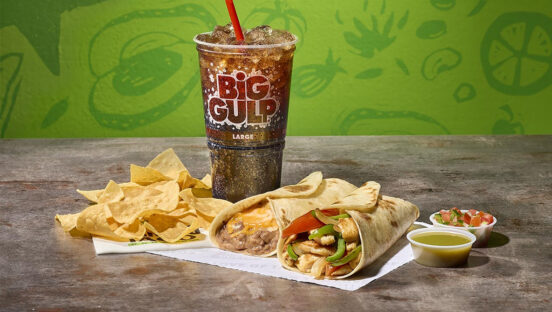
2. Bundle instead of discount. Straight price cuts erode margin fast and rarely move the needle on loyalty. Bundling does both jobs at once. Pair a fountain drink with a snack at a set price that feels like a win without actually cutting your per-unit margin to the bone. Tie a car wash add-on to a fuel purchase. Build a “fill up and fuel up” combo that nudges someone already at the pump into the store instead of driving off.
The customer perceives value because they’re getting more for a number that feels manageable, and you’re protecting your margin because you control what’s in the bundle. This is where foodservice and center-store merchandising need to work together rather than operating in separate silos.
3. Lean hard into loyalty and let the app do the price-softening. If there’s ever been a moment to push loyalty enrollment, this is it. A customer who feels every price increase individually is a customer who churns. A customer who’s earning points, unlocking a free coffee, or getting a personalized offer on their phone experiences the same price environment completely differently.
Loyalty data also lets you get granular. Instead of blanket discounting, you can target your highest-value or most price-sensitive customers with the specific offer that keeps them coming back, without discounting across your entire customer base. Retailers sitting on loyalty platforms they aren’t fully using are leaving real retention on the table right now. This is the moment to activate it, not shelve it.